









The Global Drinking Water Crisis: A Comprehensive Overview
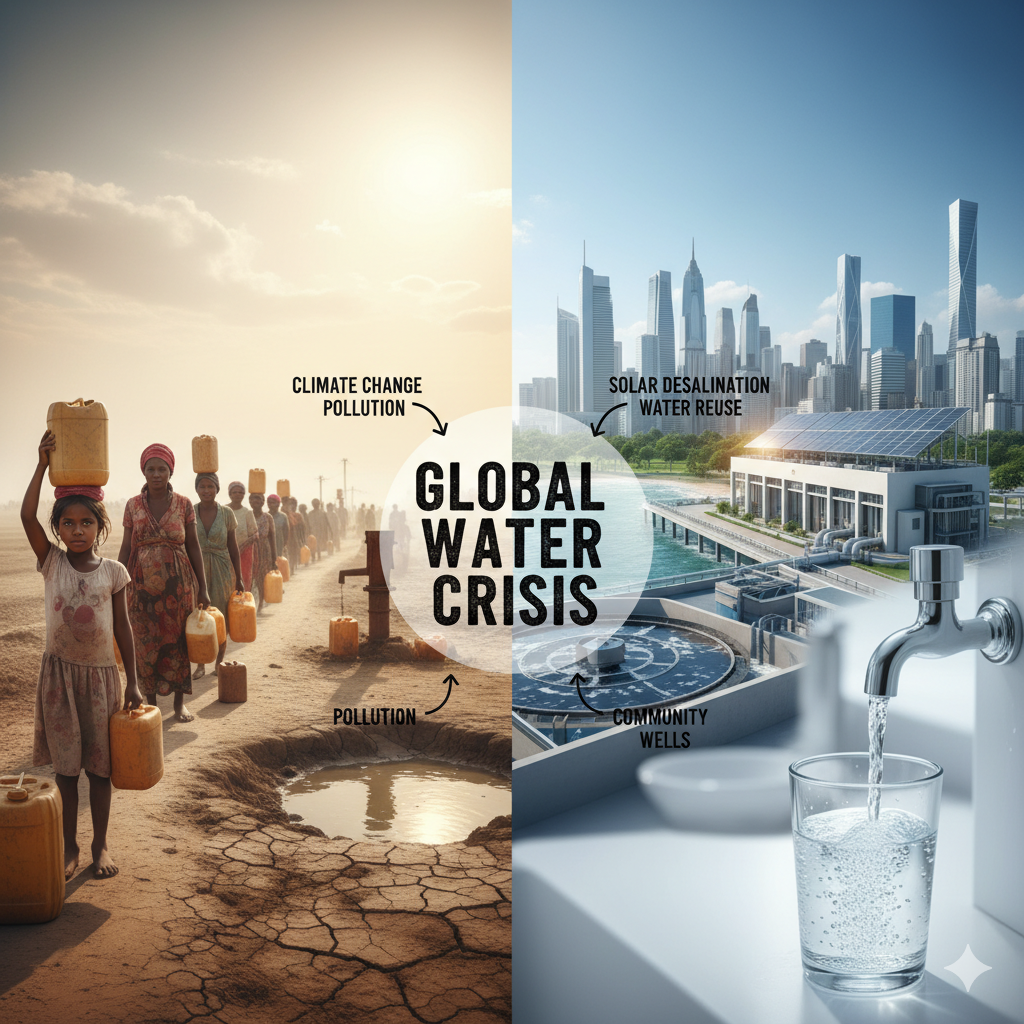
The crisis extends beyond mere scarcity; it is a complex web of environmental, economic, health, and social challenges.
I. The Scope and Statistics of the Crisis
The scale of the problem is immense and rapidly growing:
Access to Safe Water:
2.2 billion people lack access to safely managed drinking water services (Source: WHO/UNICEF).
703 million people still lack even basic access to a clean water source (Source: World Vision, as of 2022).
Water Scarcity & Stress:
By 2025, an estimated 1.8 billion people will live in areas of absolute water scarcity (less than 500 cubic meters per person per year), with two-thirds of the world's population living in water-stressed regions.
By 2030, humanity's annual global water requirements are projected to exceed current sustainable water supplies by 40%.
Half of the global population lives in countries where water tables are rapidly falling.
Sanitation and Hygiene (WASH):
3.5 billion people lack access to a safe toilet (safely managed sanitation).
1.69 billion people lack access to adequate sanitation, and 419 million people still practice open defecation.
Freshwater Availability:
While water covers $70\%$ of the Earth, only about $3\%$ is freshwater, and less than $1\%$ is accessible for human use.
II. Root Causes of the Crisis
The causes are multifaceted, driven by human activity, demographics, and environmental change:
| Category | Detailed Causes |
| Overconsumption | Agriculture: Accounts for $\sim 70\%$ of global freshwater withdrawals (up to $90\%$ in some fast-growing economies). Much is wasted due to leaky irrigation systems and cultivating "thirsty" crops in dry regions. Industry/Energy: Manufacturing water demand is projected to rise $400\%$ by 2050. Thermoelectric power plants (e.g., in the US) account for significant withdrawals. Domestic Use: The average American uses about 158 gallons per day, while 12 gallons per day are required just to sustain a human. |
| Pollution | Untreated Wastewater: Globally, $\sim 80\%$ of industrial and municipal wastewater is discharged untreated. Agricultural Runoff: Pesticides, fertilizers, and animal waste contaminate surface and groundwater. Industrial Waste: Toxic substances can leach into aquifers, with long-term, delayed effects. |
| Climate Change | Altered Water Cycle: Causes unpredictable rainfall patterns, more intense and frequent droughts, and floods. Glacier Melt: Initially causes flooding, but leads to long-term water shortages downstream. Rising Sea Levels: Contaminate coastal freshwater aquifers with saltwater. |
| Infrastructure & Governance | Weak Governance: Ineffective policies, corruption, and minimal coordination among stakeholders often fail to match water demand and supply. Degraded Infrastructure: Leaky, aging pipes and lack of infrastructure investment lead to massive water loss. Unsustainable Development: Overuse of groundwater, surface water diversions (like large dams), and unregulated urban development without adequate sanitation. |
| Demographics | Population Growth: The global population has more than doubled in the last 50 years, quadrupling water use. Growing Middle Class: The global middle class is surging, increasing consumption of water-intensive commodities and energy. |
III. Intersectional Consequences
The water crisis is not just an environmental issue; its impacts are felt across all aspects of life:
Health Crisis:
Mortality: More than 1 million people die each year from lack of access to safe water and sanitation.
Child Health: Every 2 minutes a child dies from a water- or sanitation-related disease. Water-related diseases are a leading cause of death for children under 5.
Maternal Health: Lack of clean water and hygiene contributes to high rates of disease and death among birthing mothers and newborns.
Socio-Economic Crisis:
Lost Economic Opportunity: An estimated $260 billion is lost globally each year due to lack of basic water and sanitation services. Universal access would yield $18.5 billion in benefits from avoided deaths alone.
Food Insecurity: Over half of the world's food production is at risk of failure in the next 25 years due to water instability.
Gender Inequality: Women and girls bear the primary responsibility for water collection, spending an estimated 200 million hours every day globally collecting water. This takes time away from education, work, and family care, trapping them in a cycle of poverty.
Violence/Safety: Women and girls are often vulnerable to rape and abuse while collecting water from distant sources.
Education: Children, especially girls, miss school to collect water, which hinders educational attainment and future prospects.
Geopolitical/Political Instability:
Conflict: Shared water resources among states (transboundary river basins cover $46\%$ of the globe) are increasingly likely to become flashpoints and increase the risk of internal political instability as water security diminishes.
Mass Displacement: Water scarcity could displace 700 million people by 2030.
Environmental Degradation:
Ecosystem Loss: Freshwater ecosystems have experienced an $\mathbf{85\%}$ decline in biodiversity since 1970. Wetlands, nature's water filters, are vanishing three times faster than forests.
Groundwater Depletion: Aquifers like the Ogallala in the US are being tapped at rates thousands of times greater than they are being restored.
Land Subsidence: Excessive groundwater extraction causes the land to sink, increasing vulnerability to flooding.
IV. Solutions and Opportunities
A holistic, multi-pronged approach is essential, combining policy, traditional methods, and new technology:
| Strategy | Key Actions and Innovations |
| Water Conservation & Efficiency | Agriculture: Implement drip irrigation and smart controllers using weather/soil data; promote water-efficient crops. Industry: Adopt closed-circuit cooling systems; reuse wastewater. Domestic: Fix leaks; use water-saving appliances; rainwater harvesting. |
| Water Reuse & Recycling | Wastewater Treatment: Decentralized systems treat water at the source. Innovations like Automatic Variable Filtration (AVF) and bioaugmentation are improving municipal and industrial wastewater recycling. The goal is to safely reuse treated wastewater for irrigation, industry, and eventually, potable (drinking) use. |
| New Water Sources & Purification | Desalination: Modern, energy-efficient, and solar-powered desalination plants convert seawater into freshwater. Advanced Filtration: Reverse Osmosis, Graphene filters, and Nanotechnology are cost-effective methods to remove contaminants like pathogens, heavy metals, and chemicals. Rainwater Harvesting: Simple and scalable collection and storage systems for non-potable and potable use. WaterSeer: A device that claims to accelerate production of drinkable water from air (condensation). |
| Governance and Policy | Centralized Governance: Essential for overseeing all water-related issues, from licensing wells to setting fair water prices. Collaborative Governance: Multi-stakeholder approach involving governments, NGOs, communities, and the private sector. Policy Coherence: Ensure agricultural and industrial policies are aligned with sustainable water management goals. Realistic Pricing: Remove harmful subsidies that encourage wasteful use while protecting the poor. |
| Education and Awareness | Promote understanding of the value of water and the importance of conservation from childhood through communities and industry. Incorporate WASH education into schools to improve hygiene and reduce disease. |
| Climate Resilience | Invest in climate-responsive water systems and climate-resilient infrastructure. Restore natural infrastructure like floodplains and wetlands to naturally store and filter water, mitigating both flood and drought impacts. |
Recent Posts




Pesto's Cozy Cousin: Creamy Tagliatelle with Toasted Walnut Sauce


Creamy Tomato & Mushroom Tagliatelle: Your New Go-To Weeknight Hug in a Bowl

Transform Your Entrepreneurial Journey: Introducing the Seshta Mart AI Cafe Franchise
About Seshta Mart